BLACK FRIDAY DEAL: 25% OFF THE ENTIRE COLLECTION
Diamond certificates
For round diamonds, an independent diamond report is supplied from 0.30 ct per individual stone; for other shapes, generally from approximately 0.50 ct per stone. Natural diamonds usually come with a GIA report and occasionally an HRD report. Lab-grown diamonds, including coloured lab-grown diamonds, come with an IGI report at these thresholds. Coloured natural diamonds are excluded from this policy.
Why an independent diamond report?
- GIA, HRD and IGI are internationally recognised diamond laboratories.
- The report describes the characteristics of the individual diamond.
- You will have a lifelong guarantee of the authenticity of your diamond
- For GIA reports, your unique report code lets you find the information through the GIA web page or app. https://www.gia.edu/gem-lab


What do XXXN and XXN mean?
For round diamonds we use XXXN: Excellent cut, Excellent polish, Excellent symmetry and None for fluorescence. For other shapes we use XXN: Excellent polish, Excellent symmetry and None for fluorescence. Coloured lab-grown diamonds may have different cut grades or fluorescence. The report sets out the characteristics of the individual certified diamond.
The image below shows an example of a GIA certificate.

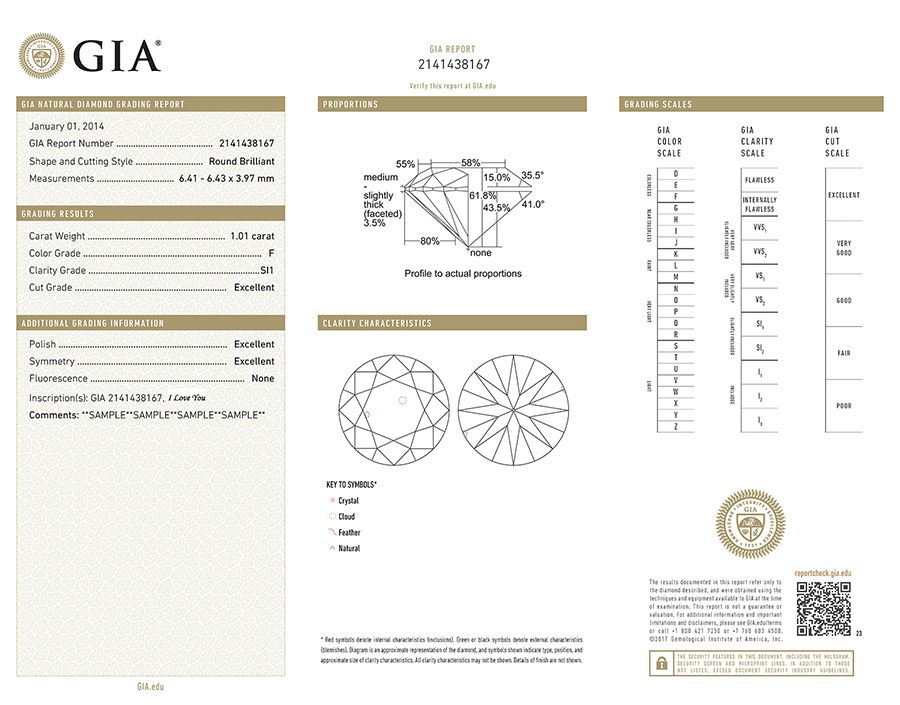
To illustrate what is written on a given certificate we provided every separate section and a short explanation below.
GIA DIAMOND DOSSIER (General information on the stone will be added under this header)
June 17, 2016: This is the date on which the report was compiled.
GIA Report Number: Every report has a unique report number so it can always be recovered from a diamond trader.
Shape and cutting style: Here the cut of the diamond is described.
Measurements: Here the measurements of the diamond will be shown.
GRADING RESULTS (the 4 C’s)
- Carat Weight
- Color Grade
- Clarity Grade
- Cut
For more information on the 4 C’s click here.
Additional grading information
Polish: This section determines the quality of the sheen of a diamond, our standard is ‘excellent’; the grade may differ for coloured lab-grown diamonds.
Symmetry: The symmetry of the stone is important for the way light enters it. Our standard is excellent symmetry; the grade may differ for coloured lab-grown diamonds.
Fluorescence
Clarity Characteristics: This is where all inclusions in the stone will be noted.
Inscription(S) GIA: This is where you will find the report number.
What is Fluorescence?
Fluorescence is a property displayed by some diamonds when exposed to UV light. When a diamond with this property is put under UV light, it will glow in a bluish hue. The higher the fluorescence score, the stronger this blue color will be.
Now you might think that this property does not affect the look of the stone during daytime, however, UV light is produced by the sun as well. It is possible that the stone appears somewhat less clear, or even that it displays an almost oily sheen. This may negatively enhance the polish and ‘fire’ of the stone. Our standard is no fluorescence; coloured lab-grown diamonds can have fluorescence.


What is the difference between a diamond and a brilliant?
Diamond is the name used for a type of stone. This name may be used for both rough and cut diamonds. When a diamond is cut, it may be cut into various shapes, or cuts. The most common cut for a diamond is the brilliant, sometimes referred to as ‘round cut’. A brilliant is symbolic of a perfectly expressed cut that allows the light to fracture in the stone in a most spectacular fashion. For more information on diamond cuts, click here.
What is the difference between SI and VS?
The difference between a SI and a VS diamond is based on the number and type of inclusions, or on the clarity of the stone.
SI (Small Inclusions): this grade is used for small inclusions, visible to the naked eye, miniscule black specks for example.
VS (Very Small Inclusions): this grade is used for diamonds that contain no inclusions visible to the naked eye. That is, a diamond that seem perfectly clear to the naked eye.
For more information on the grading and appreciation of diamonds, click here.
When do I receive an independent diamond report?
For round diamonds, an independent diamond report is supplied from 0.30 ct per individual stone; for other shapes, generally from approximately 0.50 ct per stone. Natural diamonds usually come with a GIA report and occasionally an HRD report. Lab-grown diamonds, including coloured lab-grown diamonds, come with an IGI report at these thresholds. Coloured natural diamonds are excluded from this policy. For smaller diamonds, our own certificate describes the jewellery and its specifications.
Is the quality of smaller non-certified stones inferior?
The quality of a diamond will not be inferior for the smaller stones we offer without certification. All of our diamonds are acquired from the most renowned diamond traders of Antwerp. The difference in quality applies only in GIA standards.
E.g.: A SI graded diamond will be of a relatively lower quality than a VS diamond.
How do I know my GIA report is genuine?
All GIA reports contain a hologram feature. Similar to a banknote, this certificate contains microprint lines.
GIA has decided to move to paperless certification by January 2023, for a more efficient and environmentally friendly approach to certification. This means that instead of an official document, you will receive an envelope with a QR code with your diamond certificate jewelry. This QR code leads you directly to the GIA website, and to your diamond certificate. This eliminates the need for paper certificates and reduces paper usage. You can save your certificate on any mobile device with an internet connection.
In addition, the paperless certificate is less susceptible to fraud than its paper counterpart. Because the QR code leads directly to GIA's website, you are assured of the authenticity of your certificate. Gradually, paper certificates will therefore increasingly give way to the version with QR code.
How do you know this is really the certificate for your diamond, you might think?
The serial number of the diamond is shown on the sticker with the QR code, and this serial number is engraved microscopically in the diamond by laser.