LIMITED TIME OFFER: 20% OFF SITEWIDE
How Lab-Grown Diamonds are Created: Exploring HPHT and CVD Technologies
Diamonds have always been a symbol of elegance, beauty, and luxury. They are precious gemstones that have been used in jewelry for centuries. However, traditional diamond mining has faced issues of environmental impact, unethical practices, and human rights violations. In recent years, the emergence of lab grown diamonds has created a buzz in the diamond industry.
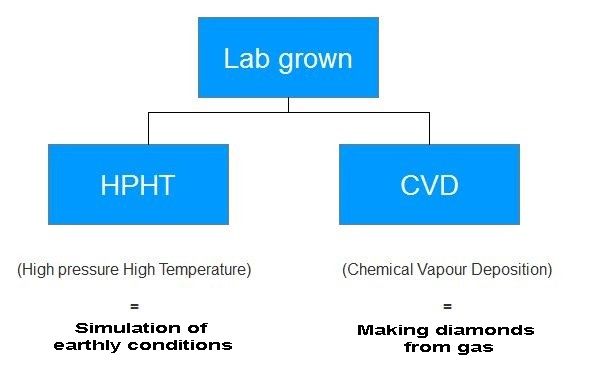
There are two different types of synthetic diamonds: HPHT diamonds and CVD diamonds. While both are called man-made diamonds or lab grown diamonds, they are created using different processes and have their own unique characteristics.
In this article, we'll take a closer look at these two types of diamonds and how they are made. We'll also explore the advantages and disadvantages of each type and provide some guidance on which type of diamond may be the best choice for different applications.
For many years scientists have tried to create imitations of diamond. From zirconia to synthetic diamond, they never mentioned to create an identical diamond. To find out more about the imitations of diamond, click here.
To find out more about the differences between diamonds and Lab Grown Diamond, click here
HPHT Diamonds vs CVD Diamonds: Understanding the Differences

Lab grown diamond through HPHT
Just like natural diamond, Lab grown Diamond consists of carbon particles. These tiny particles are placed in the machine as if they were seeds. The size of glass splinters, these particles are carefully checked for quality and pollution in order to produce the highest possible quality diamond.
The machine will compress the particles under immense pressure and incredibly high temperatures, just like the natural process. Nature, however, does not allow us to influence the particles being compressed and facilitates the occasional impurity or inclusion. This is what makes the naturally clear diamond extremely valuable.
The process, developed by scientists, is called HPHT, or High Pressure High Temperature.
Natural diamond forms at temperatures of 1204 degrees Celsius, Lab Created Diamonds, in contrast, are formed at a temperature of around 500-600 degrees Celsius.
HPHT Diamonds: How They're Made
High pressure and high temperature (HPHT) diamonds have been around since the 1950s. The process of creating these diamonds involves subjecting a small diamond seed to extreme pressure (5-6 GPa) and temperature (1,500-2,500 degrees Celsius) in a diamond press machine. This simulates the natural conditions under which diamonds are formed deep within the Earth's mantle. The carbon is then forced to crystallize around the diamond seed, creating a larger diamond.
The resulting diamonds are generally of higher quality than CVD diamonds and are used in high-end jewelry and industrial applications such as cutting tools, abrasives, and precision bearings. They can also be used in scientific research to simulate the high-pressure and high-temperature conditions found in the Earth's mantle and other planetary bodies.
Advantages of HPHT Diamonds
One of the primary advantages of HPHT diamonds is that they are structurally and optically similar to natural diamonds. They are also available in a wider range of colors, including yellow, brown, and pink. Additionally, they have a higher quality than CVD diamonds, making them a preferred choice for high-end jewelry and industrial applications.
Disadvantages of HPHT Diamonds
Despite their many advantages, HPHT diamonds are more expensive to produce than CVD diamonds and are typically smaller in size.

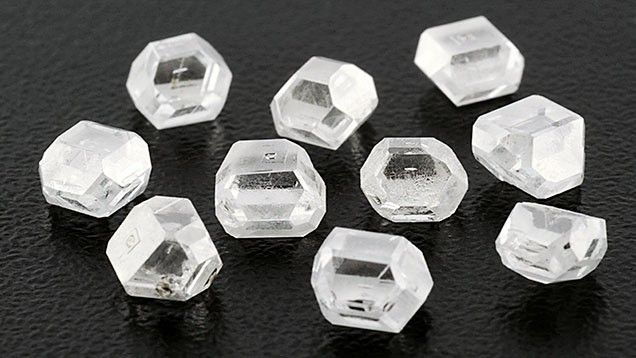
Lab grown diamond through CVD
The process of CVD diamonds is completely different from the natural process and the HPHT process. CVD means Chemical Vapor Deposition.
In CVD diamonds, a diamond is formed by evaporating a mixture of hydrocarbon gases under pressure. Diamonds are formed on a special platform where carbon remains after evaporation. Nowadays, this is one of the most used methods to form a diamond.

Difference Lab Grown and imitation diamond
Lab Grown diamonds are still regularly confused with zirconia, mossanite or synthetic diamonds, but they are definitely not the same. These are absolutely not diamonds. For more information on all diamond imitations, click here.