BLACK FRIDAY DEAL: 25% OFF THE ENTIRE COLLECTION
Emerald


Emeralds at DiamondsByMe
Emerald is a green gemstone with a character of its own. Its color ranges from fresh, light green to deep green, and its transparency varies from stone to stone.
No two emeralds are exactly alike. Colour, transparency, natural inclusions and cut give each stone its own appearance.
Natural characteristics of emerald
Inclusions are common in emeralds. They can appear as fine lines, small fissures or cloudy patterns. These natural characteristics can sometimes give the impression that the stone is damaged.
Inclusions can be clearly visible in a more transparent emerald, while another stone may appear less transparent. These features contribute to the character of each stone.
The quality of our emeralds
At DiamondsByMe, we work with emeralds ranging in quality from AA to AAA. We assess the overall appearance: color, clarity, transparency, natural inclusions, cut and size all play a part.
We consider these properties together. An emerald with more natural inclusions can still have a particularly beautiful color and appearance.
Our specialist suppliers select emeralds according to our preferences for color, clarity, cut and value for money. We then assess every incoming batch against our own quality criteria. If a batch does not meet them, we do not use those stones in our jewelry.
Our aim is a beautiful balance of color, clarity, character and price.
Below are examples of emeralds we have set for customers.

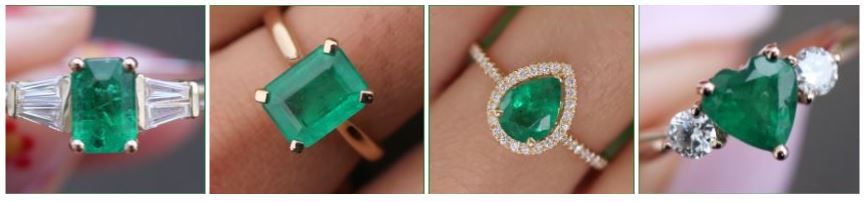
The image on the far left shows a semi-transparent emerald-cut emerald with many inclusions. The second shows a less transparent emerald-cut stone with fewer visible inclusions.
What can you expect?
Emerald is a natural gemstone, so its color, transparency, inclusions and other natural characteristics vary from stone to stone.
The examples on our website give a good impression of the appearance you can expect. Your stone may naturally differ slightly, giving it a character of its own.
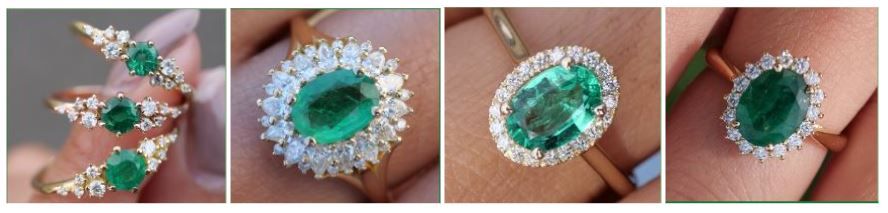
The images below show variations in color and inclusions. In the image on the far left, the middle stone is darker than the other two. The oval-cut stones also show differences in color and inclusions.
Finding your special emerald together
Do you have specific wishes for your emerald? You may be looking for a particular shade of green, size or appearance, or a stone that simply feels right for you.
If your budget is US$2,200 or more, one of our specialists can help you find your special emerald.
We begin with your preferences: the color and appearance you love, whether size and clarity are important to you, and whether you are looking for a stone with a distinctive character.
Together with our specialist suppliers, we look for suitable emeralds. When we find suitable stones, we send you photos and videos in advance so you can see and compare the options.
Choosing your emerald becomes part of the experience of creating your jewelry: a personal search for a stone that suits you and your wishes.

Care of Emerald
Almost all natural emeralds contain inclusions. Because of these inclusions, they are often treated with oil, which fills the cavities and prevents the stone from breaking quickly. This oil is not visible.
Do not place emeralds in an ultrasonic cleaner. The vibrations can cause the stone to break, and cleaning chemicals can affect the stone or dissolve its oil treatment. This may make the stone more vulnerable to breakage. We also recommend removing emerald jewelry, especially pieces with larger stones, during activities where the stone could be damaged.
Because emerald is a brittle stone, you will often see it in more closed settings at DiamondsByMe or in settings surrounded by smaller side stones. The edges of the stone are then shielded and will be less susceptible to damage. Especially in halo rings, this can give a spectacular result. Are you curious about which jewelry you can choose emerald for? Take a look at our various jewelry collections and see the options within the configurator. And who knows, you might soon be walking around with an emerald ring!
Also, check out:
- Emerald engagement rings
- Emerald gent's rings
- Emerald earrings
- Emerald pendants
- Emerald bracelets
- Emerald cufflinks
Frequently asked questions about emerald
Emeralds are green, ranging from fresh light green to deep green. Each stone has its own color and appearance.
Natural inclusions are common in emeralds. They can appear as fine lines, small fissures or cloudy patterns and contribute to the stone's individual character.
We work with emeralds ranging in quality from AA to AAA. When selecting a stone, we assess its overall appearance, including color, clarity, transparency, inclusions and cut.
Handle your emerald with care and protect it from knocks, heat and pressure. Do not use an ultrasonic cleaner: vibrations and cleaning agents can affect the stone or any treatment.
The photos give an impression of what you can expect. Emerald is a natural gemstone, so color, transparency and natural characteristics vary.
Contact our customer service team to discuss your wishes. From US$2,200, you can search for a special emerald with a specialist. When suitable stones are found, we send photos and videos in advance for you to compare.
Emeralds have an air of mystery. Known for thousands of years, they were treasured by the ancient Egyptians. With colors ranging from light to deep green, emeralds are striking gemstones. But what else is there to know about them?
Emerald Through the Ages
Emerald belongs to the beryl group and is considered the most precious stone within this group. The word was used by the Greeks to refer to any green stone, not necessarily just emeralds. Because emeralds have been known and used for thousands of years, they are also called the king of gemstones. Emeralds were found in the tombs of Egyptian pharaohs, in Pompeii and Herculaneum, and are also mentioned in the Bible. In ancient times, emeralds were also used in jewelry and made into art objects and amulets. Emerald was part of the breastplate of the Jewish high priest, in which the names of each of the twelve tribes of Israel were engraved.
Emerald Cut
The most used cut for emerald is the emerald cut. Only emerald can look so beautiful in this cut. This cut is rectangular with the corners trimmed, creating an octagonal shape. Even when the stone is full of inclusions, this gives a spectacular effect. Because emerald, like aquamarine, occurs naturally as long prismatic crystals, it is mostly cut in long shapes. By this, we mean the oval and rectangular cuts. These have one longer side. Besides the faceted cut, it is also possible to cut emerald in a cabochon shape. Many people do not expect this, but it can give a beautiful result.


Emerald: Locations and Physical Facts
For emerald, the clearer the stone, the more expensive it is. But what sets it apart from other gemstones is that emeralds can have inclusions. Gemologists can get very excited about these inclusions because they can tell a lot about how the stone was formed. For example, when there is a three-phase inclusion, it means the inclusion contains three elements: gas, a liquid, and a solid. The inclusions in emeralds are considered proof of authenticity.
Because most emeralds have many inclusions, they are very sensitive to shocks, heat, and pressure despite their hardness. If an emerald is strongly heated (think of a temperature above 700 degrees Celsius), it loses its color.
Molecular Formula of Emerald: Be3Al2(SiO3)6
Hardness of Emerald on the Mohs Scale: 7.5 / 8
Emerald can only be scratched by materials that are harder or have the same hardness. For example, ruby can scratch an emerald. The toughness of emerald is poor. Due to the poor toughness, the stone is sensitive to fractures when handled roughly. Depending on the amount of inclusions, the stone can break quickly.
The oldest known location of emerald is in the southern part of Egypt, the former Upper Egypt. These Cleopatra VII mines were forgotten in the Middle Ages but were rediscovered in the 19th century. Today, emeralds are mainly found in Brazil, the United States, Europe, and along the Tokovaya River in Russia. Other locations include Colombia (Colombian emerald, a variety that contains vanadium), India, Afghanistan, Pakistan, South Africa, Zambia, Zimbabwe, Ghana, Nigeria, Tanzania, and Namibia.


Symbolism and Healing Properties of Emerald
The king of gemstones captures the imagination and, because of its characteristic color, everyone is familiar with the name emerald green. In some cultures, it is customary to give emerald as a traditional gift on a 55th wedding anniversary. Additionally, emerald is the birthstone of May and the stone of the Taurus and Gemini zodiac signs.
Emerald is traditionally believed to dispel negativity and encourage healing and wisdom. It has also been associated with memory, decision-making, easier breathing during meditation, and the health of the eyes, muscles and immune system.
Imitations
Common imitations for emerald include green tourmaline, glass, aventurine quartz, green-dyed quartz, and Soudé emerald. Glass is often used to imitate lower quality emerald.

